
The biological impact of viruses on the evolution of eukaryotic genomes
Event
While recurrent epidemics have highlighted viruses for their potential to cause disease, this conference will focus on aspects having to do with their global impact on the evolution of species.
Informations pratiques
Location
Grande salle des séances - Institut de France - 23 quai de ContiDate
-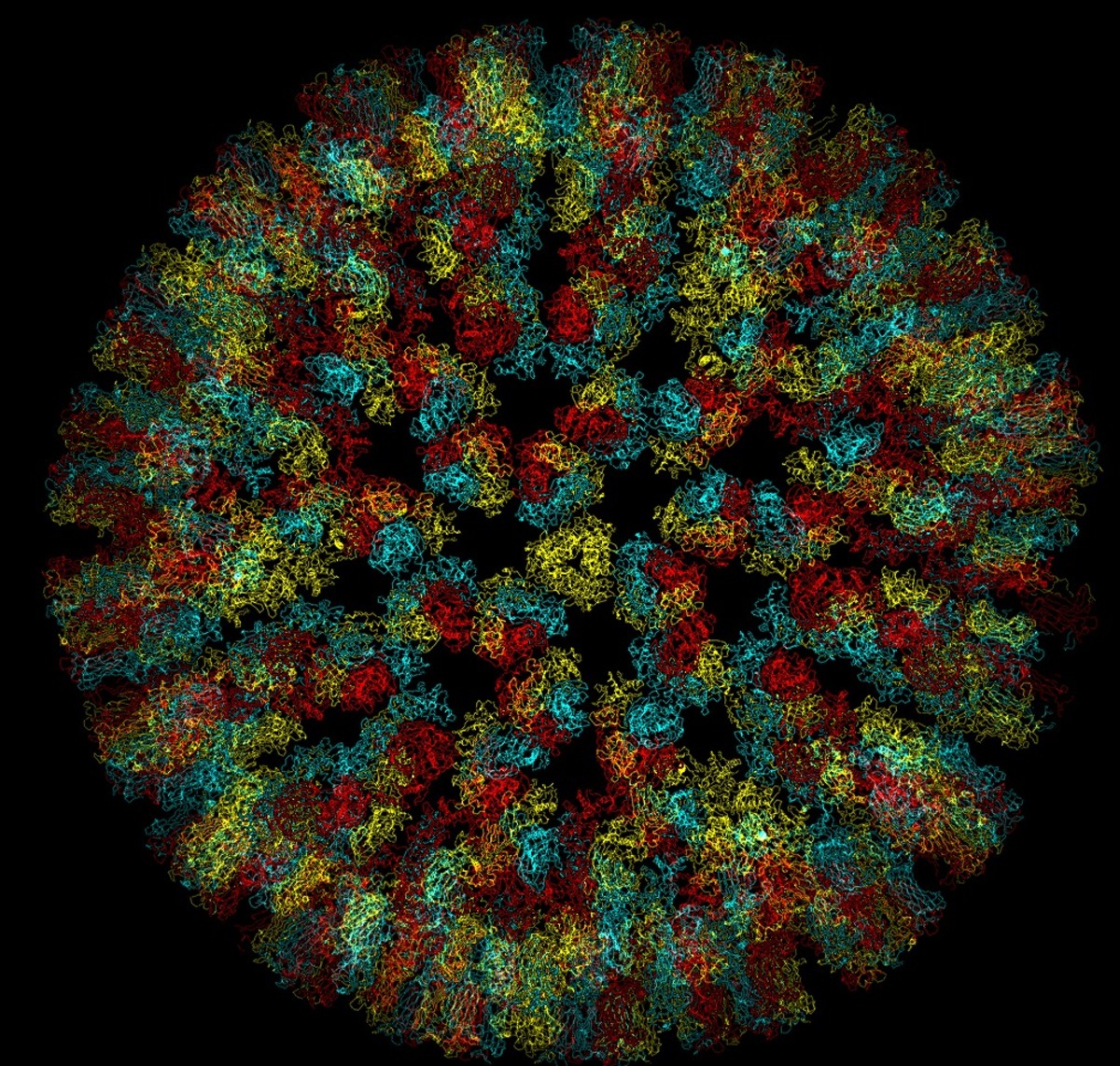
Reconstruction of the structure of a whole virus by combining radiocrystallography and cryo-microscopy. © Félix REY/Jean COHEN/PRASAD BVV/CNRS Images
Compelled to infect a host cell or organism in order to perpetuate themselves, viruses have actively participated in the evolution of species since the origin of life. Similarly, transposable DNA elements (transposons) have contributed to this evolution.
The human genome contains around 8% of sequences from endogenous retroviruses, and almost 40% of sequences are derived from transposons. Viruses are known to the general public for the diseases they cause, but this aspect represents only a tiny fraction of their impact on living beings. They affect their host organism indirectly by forcing it to evolve to protect itself, but also by acting directly on the genome sequence.
The aim of this conference is to analyze the impact that viruses and transposons have had on the host genome during evolution. The function of viral sequences or transposons as elements controlling the expression of cellular genes will be discussed, as well as the essential functions of genes of viral origin adopted by the host along its evolution. The discussion will be restricted to multicellular organisms, but it should be remembered that bacteriophage genome fragments are very frequently incorporated into bacterial genomes and play an essential role in the ecology of the prokaryotic world.
This conference and organized by Félix Rey, member of the Académie des sciences and director of research at the CNRS, and Moshe Yaniv, member of the Académie des sciences, professor emeritus at Inserm and director of research emeritus at the CNRS.
[MORE INFORMATION AND REGISTRATION COMING]